Search Results
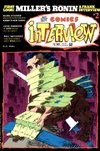
Comics Interview — Issue #002 (April 1983)
interview
Frank Miller
... Ronin, the project he conceived while researching martial arts for Daredevil. Miller explains the samurai philosophy underpinning the series — "if you intend to die, you can do anything" — and the theme of modern disenfranchisement connecting fe...
Show more
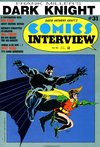
Comics Interview — Issue #031 (February 1986)
interview
Frank Miller
Miller discusses The Dark Knight Returns, his four-issue series set twenty years in the future featuring a fifty-something Batman returning from retirement in a politically dystopian America, with Superman recast as a government agent and enemy. He...
Show more
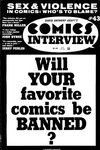
Comics Interview — Issue #043 (February 1987)
interview
Frank Miller
Miller spoke at the 1986 Mid-Ohio-Con on censorship and ratings, arguing firmly against any ratings system for comics, warning that the industry "did not act courageously last time there was a threat" (referencing the Wertham era when Bill Gaines was...
Show more
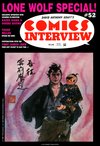
Comics Interview — Issue #052 (November 1987)
interview
Frank Miller
Miller discusses the comics censorship controversy in detail, recounting how DC's proposed ratings system came about after pressure from religious groups, and how he organized a petition signed by Alan Moore, Howard Chaykin, and Marv Wolfman, which h...
Show more
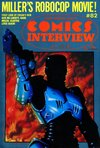
Comics Interview — Issue #082 (May 1990)
interview
Frank Miller
Wide-ranging dinner conversation covering Miller's two years writing the RoboCop 2 screenplay, his working relationship with director Irvin Kershner and producer Jon Davison, and the seven-draft development process. Miller discusses his three forth...
Show more
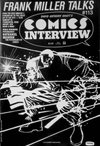
Comics Interview — Issue #113 (December 1992)
interview
Frank Miller
Wide-ranging conversation covering Miller's just-completed Sin City — a solo 200-page graphic novel he describes as a lifelong dream project — as well as RoboCop vs. Terminator (scripted for Walt Simonson to illustrate) and his RoboCop 3 screen...
Show more
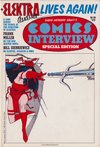
Comics Interview — Special Edition - Elektra (1990)
interview
Frank Miller
Miller explains why his next wave of work is going to Dark Horse rather than Marvel or DC, citing growing corporate bureaucracy, the risk of outside pressure on mature content, and the desire to retain merchandising control over creator-owned work. H...
Show more
Comics Interview — Special Edition - Elektra (1990)
interview
Frank Miller
A second, shorter piece transcribed from Miller's 1986 Mid-Ohio-Con appearance covers his views on comics ratings and censorship. He argues strongly against any industry rating system, warning it would empower religious fundamentalists, chill creativ...
Show more
Comics Interview — Issue #052 (November 1987)
article
Spotlight: Censorship (Frank Miller, int. Mark Borax)
A standalone feature-length interview in which Miller lays out the full timeline of the DC ratings system controversy and advocates for an anti-censorship information booklet he is assembling from editorials by Mark Evanier, Alan Moore, Chris Claremo...
Show more
Comics Interview — Issue #001 (February 1983)
interview
Steve Gerber
...comics' lack of creativity — "recycled 1960s comic books" — while singling out Frank Miller's Daredevil and Dave Sim's Cerebus as the exceptions. Voices strong optimism that independent publishers like Eclipse and Pacific are "redefining the main...
Show more
Comics Interview — Issue #001 (February 1983)
interview
Terry Austin
Discusses finishing Frank Miller's final Daredevil issue, wrapping up The Further Adventures of Indiana Jones after John Byrne's departure over a conflict with Lucasfilm, and discovering new talent Kevin Nowlan for Dr. Strange. Reflects on his ...
Show more
Comics Interview — Issue #005 (July 1983)
interview
Phil Lasorda, Gerry Giovinco, Bill Cucinotta & Bill Anderson
... speak effusively about Matt Wagner's Grendel, predicting he will be "the next Frank Miller." They discuss their upcoming transition from black-and-white to four-color printing, their emphasis on advertising, and their philosophy of being artists f...
Show more
Comics Interview — Issue #006 (August 1983)
interview
John Workman
...ity-obsessed fans while newsstand distribution collapses in smaller towns. Praises Frank Miller's Ronin as proof that "an American can shoot the Europeans right out of the water" and hopes Epic and other publishers will create more Heavy Metal-style ...
Show more
Comics Interview — Issue #007 (January 1984)
interview
Nick Landau & Mike Lake
...merica. Landau notes that American professionals highly rate Judge Dredd, with Frank Miller specifically requesting to meet artist Mike McMahon at a British convention, and announces Robo-Hunter as their second title with plans for mini-series of...
Show more
Comics Interview — Issue #011 (May 1984)
interview
Doug Moench
... comics press's tendency toward extreme lionization and sudden dismissal, citing Frank Miller and Don McGregor as victims of this cycle, and dismissing the lavish praise for Love and Rockets as publisher-driven hype.
Show more
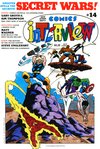
Comics Interview — Issue #014 (August 1984)
interview
Matt Wagner
Wagner, described by Comico colleagues as "the next Frank Miller," discusses Mage, his fifteen-issue series in which the protagonist Kevin is visually modeled on Wagner himself — a deliberate choice to take the comics trend of creators appearing in t...
Show more
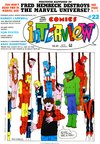
Comics Interview — Issue #022 (April 1985)
interview
Tom Yeates
...r, Roy Krenkel, and Al Williamson over the cinematic violence he associates with Frank Miller. He recounts his training at the Kubert School's inaugural class alongside Steve Bissette, Rick Veitch, and John Totleben, his early work assisting Al Willi...
Show more
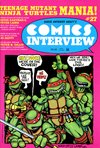
Comics Interview — Issue #027 (September 1985)
interview
Kevin Eastman & Peter Laird
... grew to 50,000 copies by issue #3. They discuss how the book began as a parody of Frank Miller's Ronin and Daredevil but has evolved into a more straightforward adventure comic, and outline plans for a Fugitoid one-shot and Michaelangelo holiday mic...
Show more
Comics Interview — Issue #031 (February 1986)
article
Editorial: Up Front (DAK)
...rently contradictory but collectively illuminating — alongside interviews with Frank Miller and Burt Ward creates a perspective spanning nearly five decades of the character.
Show more
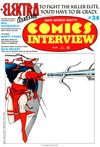
Comics Interview — Issue #034 (May 1986)
interview
Bill Sienkiewicz
...hris Claremont (emotionally driven, soap-opera storytelling on New Mutants) versus Frank Miller (thematically and politically driven on Elektra), calling Elektra "a punk book — counterculture, very political." He also discusses plans to begin writing...
Show more
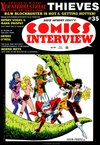
Comics Interview — Issue #035 (June 1986)
article
The Last Word (Letters)
A letter from reader Amy Sddks offers a lengthy contrarian critique of Frank Miller's celebrated status, arguing that "godlike" heroes and increasingly pretentious prestige comics miss the point, and recommending interviews with Howard Cruse, Karl Ke...
Show more
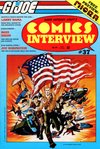
Comics Interview — Issue #037 (August 1986)
interview
Steve Gerber
...rning pro-social programming called "The Wrong Stuff." He also reveals that he and Frank Miller had pitched a far more radical Superman revamp to DC before the Byrne version was chosen, and that the deal fell through over the "Superman bake-off" conc...
Show more
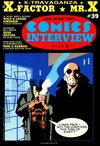
Comics Interview — Issue #039 (October 1986)
interview
J. Marc DeMatteis
...ies in creator-owned work outside the mainstream superhero square, and singles out Frank Miller, Alan Moore, and Steve Gerber as exemplars of the driven, personal vision that makes great comics. He also previews an upcoming Doctor Fate project with K...
Show more
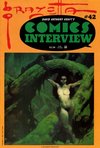
Comics Interview — Issue #042 (January 1987)
interview
Steve Ringgenberg
...st comic on the market, and is sharply critical of Chris Claremont's verbosity and Frank Miller's insularity. He also discusses his role as associate editor at Byron Preiss Visual Productions, where he is adapting Bradbury, Bloch, and H.G. Wells stor...
Show more
Comics Interview — Issue #052 (November 1987)
interview
Rick Oliver
...unts how Global Communications approached First at the 1985 ABA convention and how Frank Miller's name became the key marketing hook for Lone Wolf and Cub's American debut. He explains the production decisions — perfect-bound format, $1.95 price poin...
Show more
Comics Interview — Issue #061 (August 1988)
interview
Paul Chadwick
... not the high-concept idea, that give the book its value. He also reveals that Frank Miller was an early APA-5 member alongside himself and several future Dark Horse principals.
Show more
Comics Interview — Issue #072 (July 1989)
interview
Steven Grant
...g of WAP (Words and Pictures), the freelancer communication network organized with Frank Miller and Steve Gerber.
Show more
Comics Interview — Issue #073 (August 1989)
interview
Dominique Rasquain & Bruno Terrier
...pective — noting that superheroes are a hard sell in France, that John Byrne and Frank Miller are the most popular American creators, and that Chaykin's Shadow was perceived as anti-communist by French readers. Both discuss their rapid receipt of n...
Show more
Comics Interview — Issue #083 (June 1990)
interview
Matt Wagner
... 11 filing. Wagner also reflects on his artistic influences (Will Eisner's Spirit, Frank Miller, European albums, Japanese manga) and upcoming projects including a Three Musketeers adaptation for First's Classics Illustrated and an erotic graphic nov...
Show more
Comics Interview — Issue #088 (November 1990)
interview
Fulvia Serra
...nt market contraction, *Peanuts*' enormous Italian success, and plans to introduce Frank Miller and Alan Moore's works to Italian readers.
Show more
Comics Interview — Issue #099 (October 1991)
interview
Simon Bisley
Bisley traces his artistic influences (Frazetta, Sienkiewicz, Frank Miller) and his path into the comics industry through Titan Books connections and early DC work on Doom Patrol covers. He argues that black-and-white line art carries more raw energy...
Show more
Comics Interview — Issue #100 (November 1991)
interview
Chris Claremont
...ments — the Dark Phoenix saga with John Byrne, the Wolverine limited series with Frank Miller — and Jim Shooter's executive decision to revive Jean Grey against his wishes. He confirms he is writing the first three issues of the new X-Men title and h...
Show more
Comics Interview — Issue #111 (October 1992)
interview
Walt Simonson
...our-issue RoboCop vs. Terminator series for Dark Horse, scripted Marvel-style by Frank Miller, detailing how the two collaborated and praising Miller's careful story structure. He covers his wide range of concurrent freelance projects and reflects ...
Show more
Comics Interview — Issue #113 (December 1992)
article
Editorial: Up Front (Julia R. Mather)
...orial on the theme of creative collaboration in comics, citing Alberto Breccia and Frank Miller as exemplars, and anticipating future international co-productions between U.S. and European/Japanese artists.
Show more
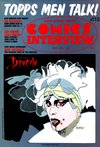
Comics Interview — Issue #115 (February 1993)
interview
David Mazzucchelli
...re's artistic validity. He reflects on his collaborative working relationship with Frank Miller, his artistic influences (Gene Colan, Kirby, Roy Crane), a nine-month stay in Italy that shaped his graphic sensibility, and his decision to self-publish ...
Show more
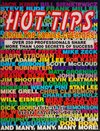
Comics Interview — Hot Tips From Top Comics Creators #1 (1994)
article
Summary
...ans like Joe Kubert, Carmine Infantino, and Dick Sprang to then-current stars like Frank Miller, George Perez, and Bill Sienkiewicz, with each contributor briefly profiled in a "Tipsters" biographical section before the tips chapters begin. The volum...
Show more
Comics Interview — Special Edition - Elektra (1990)
interview
Bill Sienkiewicz
...edevil* graphic novel with Miller. He compares his creative relationships with Frank Miller and Chris Claremont, reflects on breaking from his early Neal Adams-derived style during New Mutants, and discusses his ambitions to write as well as draw.
Show more
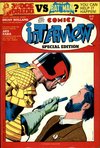
Comics Interview — Special Edition - Judge Dredd vs Batman (January 1985)
interview
Brian Bolland
... collapsed Batman Meets Judge Dredd project scripted by Alan Moore and reflects on Frank Miller's influence on the field.
Show more
Comics Interview — Issue #034 (May 1986)
interview
Marty Pasko
Pasko explains his quiet departure from comics roughly two years prior, driven by disillusionment with the superhero-only marketplace and his desire to work in anthology formats that no longer existed. He contrasts his constrained run on Swamp Thing ...
Show more
Comics Interview — Issue #034 (May 1986)
interview
Alan Weiss
Part two of Weiss's interview covers the creation of the Marvel KISS Super Special, including the story of Stan Lee attending a Kiss concert where a firecracker went off under his seat. Weiss discusses his philosophy of collaborative storytelling — p...
Show more
Comics Interview — Issue #034 (May 1986)
interview
Rick Bryant
Bryant recounts his thirteen-year journey from a Virginia coal-mining background through DC staff work, background inking for Marvel and DC, science fiction magazine illustration, and arcade game art, to his recent breakthrough inking The Badger for ...
Show more
Comics Interview — Issue #034 (May 1986)
article
Editorial: "What Does a Publisher Do?" (DAK)
Second in a series, DAK humorously describes the realities of publishing: committing to a project in a flash of optimism, setting impossible deadlines, and the inevitable scramble that follows.
Show more
Comics Interview — Issue #034 (May 1986)
article
Letters: The Last Word
Reader letters discuss the Batman/Superman comparison, praise for issue #31, and requests for back issues; DAK responds briefly to each.
Show more